
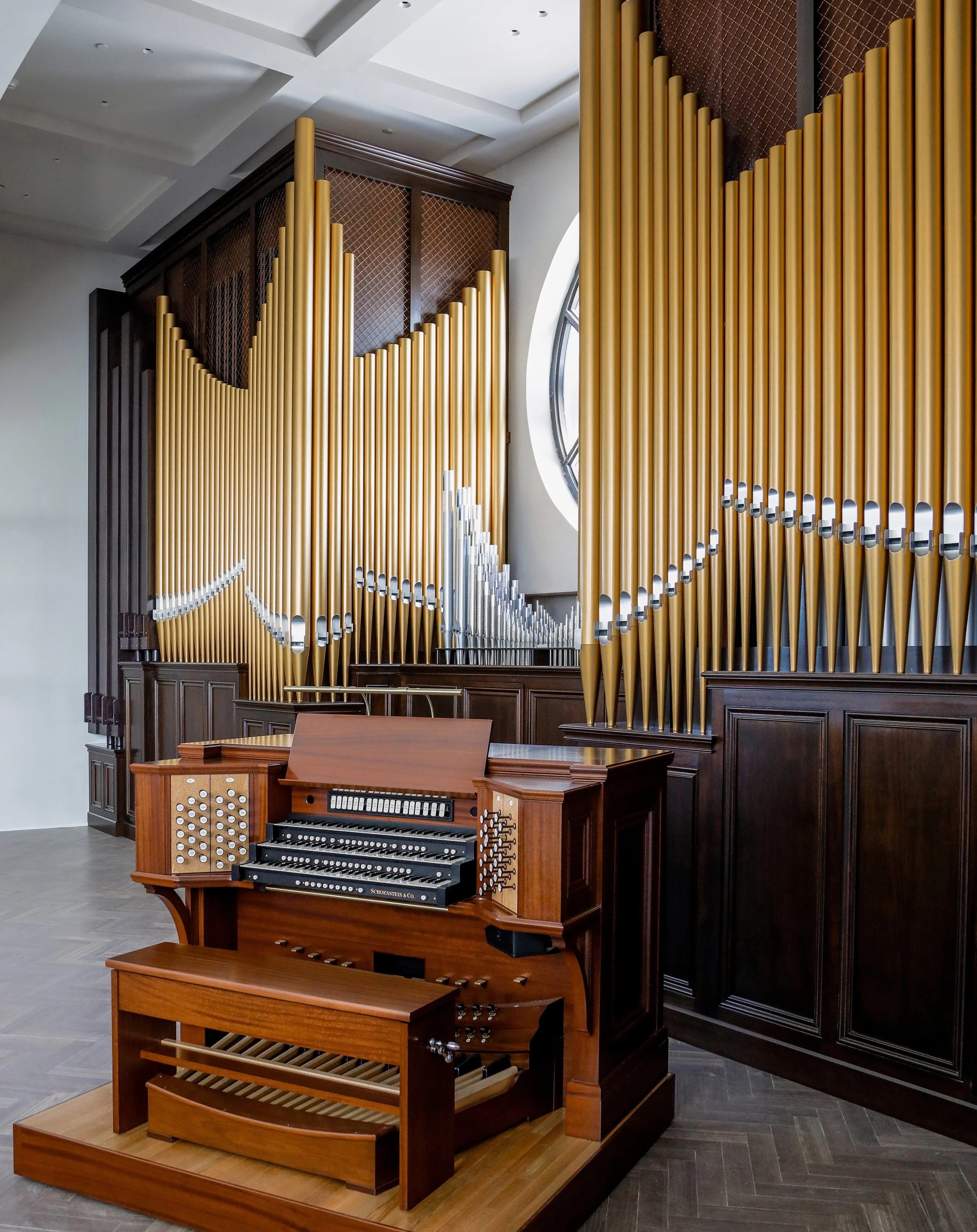
The Organ Case
The visual appearance of the organ is important to everyone regardless of their interest in music. In recent decades, American organ builders have faced new challenges in designing organ cases. For centuries, most churches were built along strictly traditional lines. Now we have buildings of entirely new shapes, styles and materials. Placements of organ and choir have changed. Space for the organ is often restricted. Budgets are usually limited. Memorial windows cannot be blocked. Some builders see these changes only as problems; we see them as opportunities to test our creativity.
Great care must be taken when designing a new organ case. It needs to strike the right balance between beauty and subtlety, and should look like the organ has been in place since the building was built. These aesthetic considerations require an expert’s hand, and so we rely on renowned liturgical architects to help design our cases.
The Organ Console
Since the advent of the detached console in the nineteenth century, the greatest master builders have elevated console design to a fine art. Their consoles are recognized for elegant proportions, beautiful materials exquisitely finished, refined appointments, and, above all, player comfort.
The console most appreciated is the one least noticed by the organist. It must facilitate musicianship, never stand in the way. Dimensions that allow a comfortable playing position are vital, as are the design and layout of playing aids.
Each Schoenstein console is custom made, but the same design philosophy guides our work:
1) Player comfort is the deciding factor in all design decisions.
2) Simplicity in console controls is key, employing only the most often-needed playing aids in an uncrowded layout.
3) Convenient placement of playing aids is more important than the number of them.