
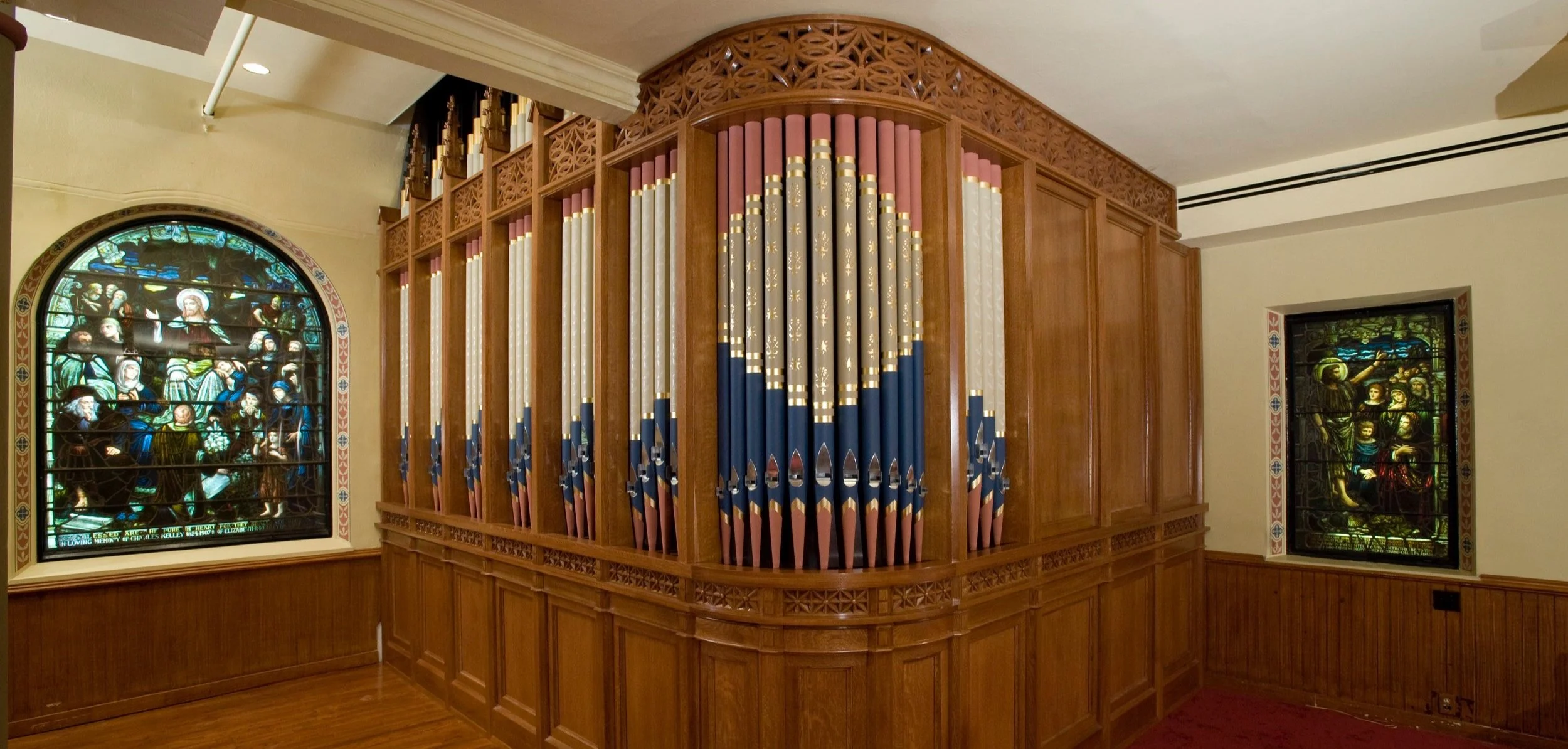
The Schoenstein Sound: A Symphonic Organ
All musicians – from the most versatile to the specialist – have a voice, and the same is true for organs. The Symphonic Organ seeks to possess the color variety, beauty, expression, versatility, and impact of the symphony orchestra. It does so not by imitation of instruments or historical reproduction, but via a compelling musical voice.
Building one organ to sound perfect in every context is impossible.
Building one organ to sound musical in every context is essential.
Beautiful
Useful
Serviceable
The goal of any new organ project is to create an instrument that is inspiring and appreciated for generations. Transforming a sixty-year cycle of replacement into a pattern of centuries-long preservation requires an organ that is beautiful, useful, and serviceable. With these three elements, the eventual question of restore or replace will be answered with a resounding, “save our organ” thanks to its essential position in the community and economical refurbishment cost.
Beautiful Tone
A balanced, beautiful organ sound is centered around warm, 8-foot tone. This tone is what will support a choir, lead a congregation, and envelop the listener in even the toughest acoustical setting. Deriving power from reeds – not always upper-work – allows the organist to lead a full church in singing or thrill an audience while keeping even the loudest sounds pleasing.
An organ centered around 8-foot tone will naturally have fewer ranks per square foot due to the number of large-diameter pipes. However, we think that tone quality, rather than quantity, is the most important part of a new organ.
Tone quality depends on careful scaling and voicing, something that begins with our decades-long study of organs near and far, and ends with the tonal test, listening to pipes of different scale and loudness on a special test chest in the space planned for the new instrument. This test of scale and volume, plus aural intuition, gives us an empirical basis on which to design the whole organ. It is the combination of experience and systematic listening that yields a musical organ.
Useful Design
Beautiful tone is not enough to ensure a successful new organ. The new instrument must also serve the musical needs of its institution. It should enhance the talents of the organist and be designed around its role in the wider music program. This allows the project to be seen as important to all, not a luxury enjoyed by few.
We believe that new organs should be as small as possible to do the musical job. To that end, we focus all our effort on expression and versatility before adding more voices to the design. The smaller the organ, the more creativity is required; a successful small organ is the real hallmark of a great builder.
Serviceable Layout
Even the most beautiful, useful organs risk replacement if they’re difficult to maintain. All organs, no matter their action type, materials, or design, require both regular service/tuning and occasional restoration after several decades.
Tuning and maintenance must be central to the new organ’s layout. This is critical to its long-term success both tonally and mechanically. Overlooking serviceability results in more expensive, less successful tuning, deferred maintenance over time, and exponentially-higher costs for eventual restorative projects.
The Schoenstein Expansion Cell™
Speed and precision of both key and stop action are critical to the success of an organ. Key action must be lightning fast on both attack and release and respond uniformly from all keys regardless of the number of stops or couplers employed. Stop action must be fast and clean, without any hesitation or gulping on draw or release. The system must be silent.
The organ is only as musical as it is responsive.
To meet these requirements we use electric-pneumatic action with an individual-valve wind chest. Our current chest and action design is the result of 100 years of research and design in performance and longevity. Our design design builds the Expansion Cell™ into the toe board, allowing for precise valve tolerance in all climates. It also lets us adapt the depth of the Expansion Cell™ to the needs of each voice: normal depth for most flues, limited depth for reeds.

A rock-solid wind system combined with a precision chest and action design results in pipes that speak absolutely independent of one another under any circumstance. By maintaining total uniformity in sonic result, the performer knows what will happen every time a pipe is played, the best way for an artist to achieve lyrical phrasing, clear articulation, and accent.
The Schoenstein
Double Expression
System

A good expression box when fully open should not rob the pipes of clear projection and presence, but when closed should reduce loudness from at least ff to pp. To achieve this, a box must be reasonably sound-proof and well sealed; gaps are anathema to good expression-box control. The shades cannot be too thick; their bulk will not permit a full use of the opening. Shades should be able to open nearly 90° and seal tightly when closed. They must be fast-acting and silent. Achieving smooth, continuous expression control is one of our main goals.
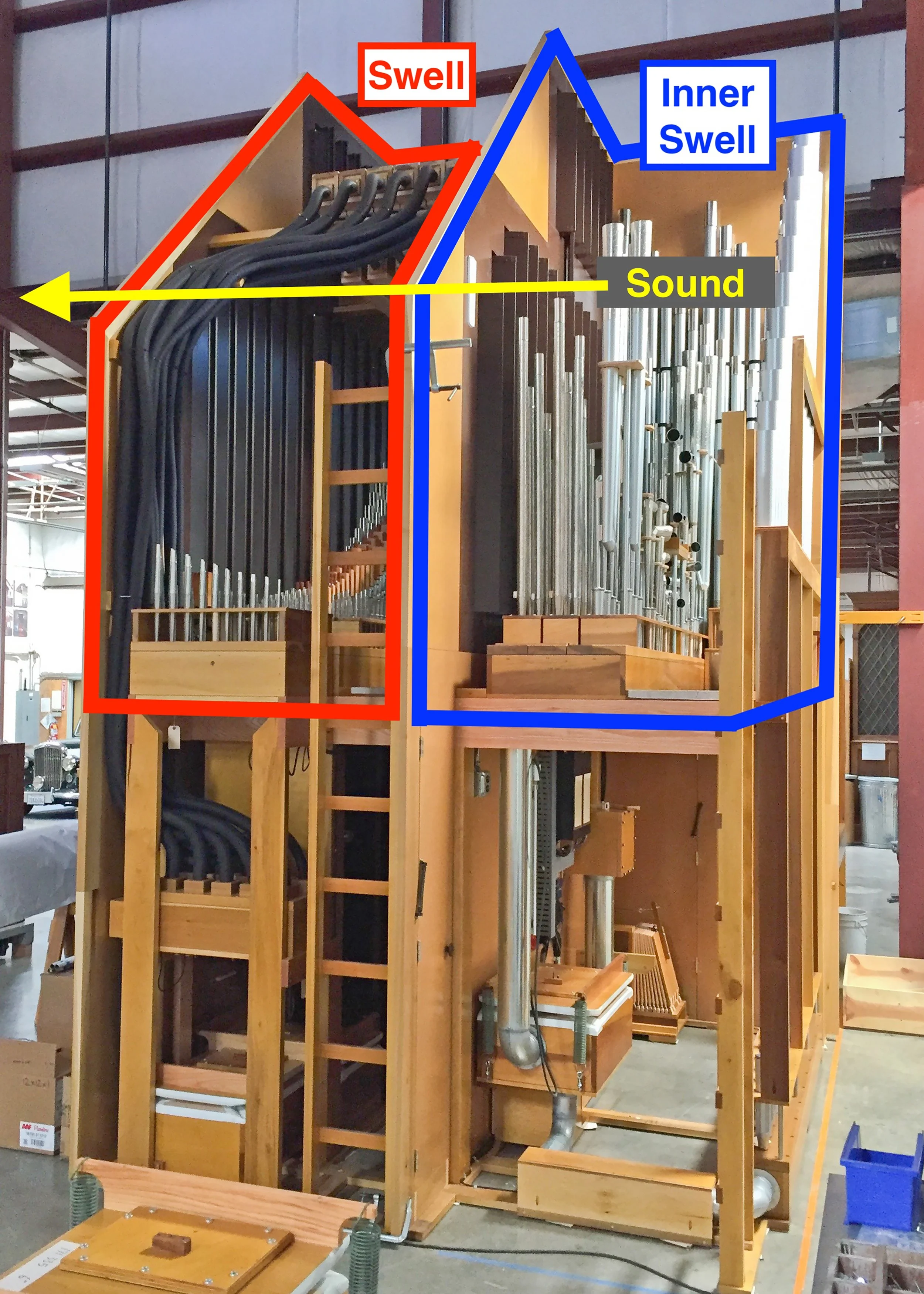
To increase the continuous dynamic range from fff to ppp we have developed a system of double expression, placing one expression box within another. The inner box is placed at the rear of the outer box so that there is a large air space between the two sets of shades. When both sets of shades are closed, the space contained between them provides a very effective sound-trap. We place the softest as well as the most powerful sounds inside the inner box: for example, a pair of ethereal strings and the Vox Humana plus the high-pressure chorus reeds and a mixture.
A balanced expression pedal is provided at the console for each box. With both sets of shades fully closed, the soft stops in the inner box are reduced to near-inaudibility and the chorus reeds are reduced to the level of color reeds. With the inner shades partially open, the loud stops can sensitively accompany a choir. With all shades fully open, the chorus reeds and mixture give their full power to the organ in service music and solo repertoire. The Vox Humana usually has its own shades with a console switch to shift from pp to mf.
Organs with double expression can be played in the traditional manner simply by disengaging the double expression feature or using two balanced pedals together.
Quick Start Guide
Below are just a few of the expressive possibilities with Double Expression. They can all be done with ease after a bit of practice.
-
A perfect crescendo is expected of most musicians and easier to achieve on the organ with Double Expression.
Begin with strings and both boxes closed, opening the inner box until the level is equal to the soft stops in the outer box. Build up registration and open the outer box in the normal manner while closing the inner box. Draw the chorus reeds and mixture, then re-open the inner box to complete the crescendo.
-
With the inner box closed, the full chorus reeds and mixture can be used with even the most delicate singers.
Leave the inner box closed, registering as normal and controlling volume with only the outer box.
-
The Swell Trumpet gains chameleon powers thanks to Double Expression.
With the inner box closed and outer box half-open, the Trumpet becomes a Flügel Horn fit for solos and rich chorus work. Adjust the inner box to control color, the outer box to control volume.
-
Solo Tubas and the like can easily function as chorus reeds by closing the inner box.
For a final, thrilling crescendo, open the inner box slightly on the last chord.
-
Even the 32’ Contra Posaune can be used in myriad ways with Double Expression.
With both boxes closed and all strings drawn at 16’ and 8’, add the 32’ (only) Contra Posaune to simulate the Wanamaker Organ string effect.
Use the outer box (and other divisions) to control volume, leaving the inner box closed.